Large brands have an obvious advantage in AI search. They have more recognition, more coverage, more reviews, and usually a much larger public footprint.
There is evidence that this familiarity matters. A 2026 study of nearly 4,000 AI responses found that models searched for brands they were already familiar with 55.7% of the time, compared with 17.4% for unfamiliar brands.
That makes the challenge for a smaller company look difficult. If AI already knows the category leaders, why would it recommend a smaller alternative?
We ran a small experiment to find out.
What we found was not that company size stopped mattering. Instead, the recommendation changed as the buyer became more specific. A smaller specialist that did not appear at all in a broad category search could become the first recommendation once the question matched the buyer, problem, and buying considerations it was positioned around. It makes brand positioning in AI search especially important for smaller companies: they may not need to win the category if they can become the clearest fit for the right buying situation.
What Happens When the Question Gets More Specific?
We tested this across ChatGPT and Claude using two different software categories.
We did not name the smaller companies in the prompts. Instead, we started with a broad recommendation question and gradually gave the AI more information about the buyer.
The first test was customer support software.
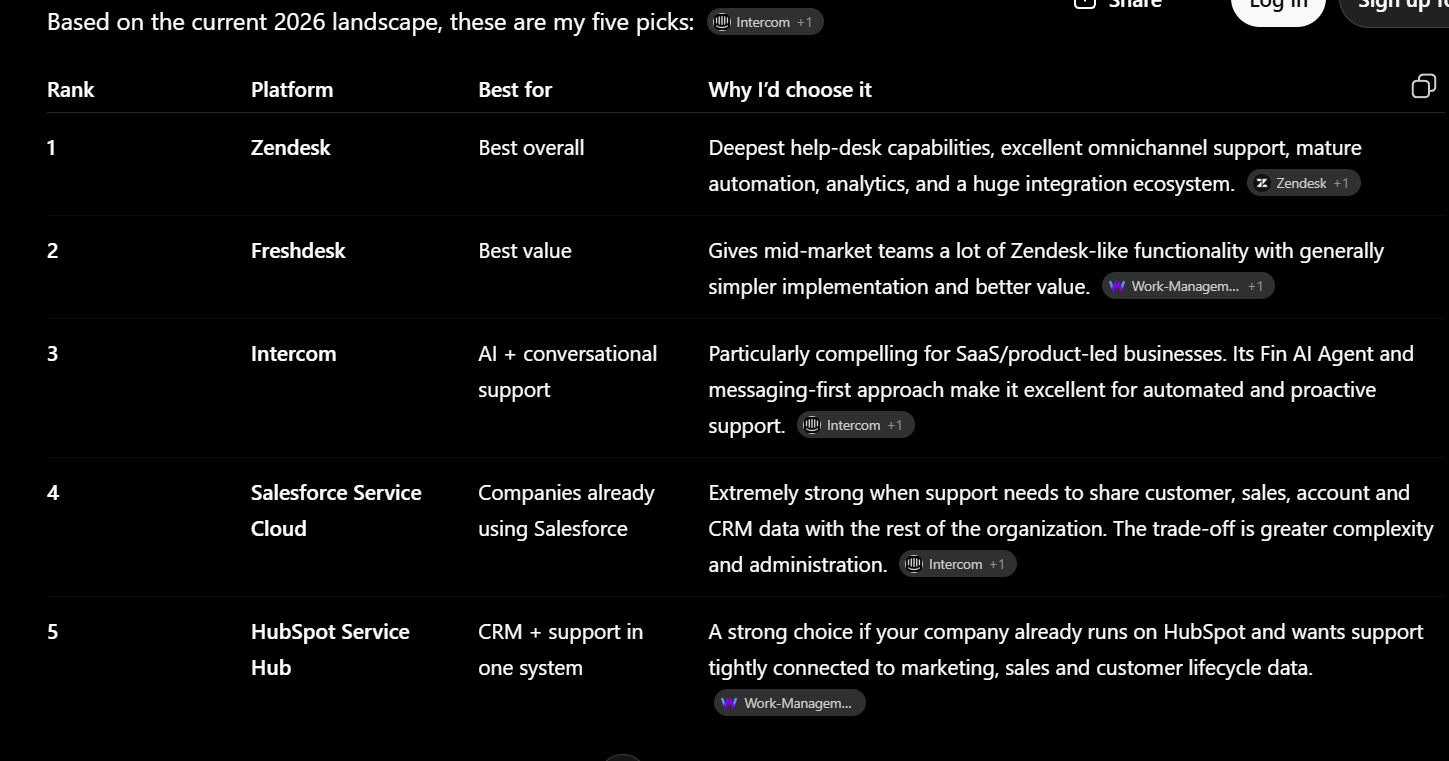
We initially asked for the best customer support platforms for a mid-sized company.
Both ChatGPT and Claude put Zendesk first. Freshdesk and Intercom also ranked near the top. Gorgias did not appear in either model's top five.
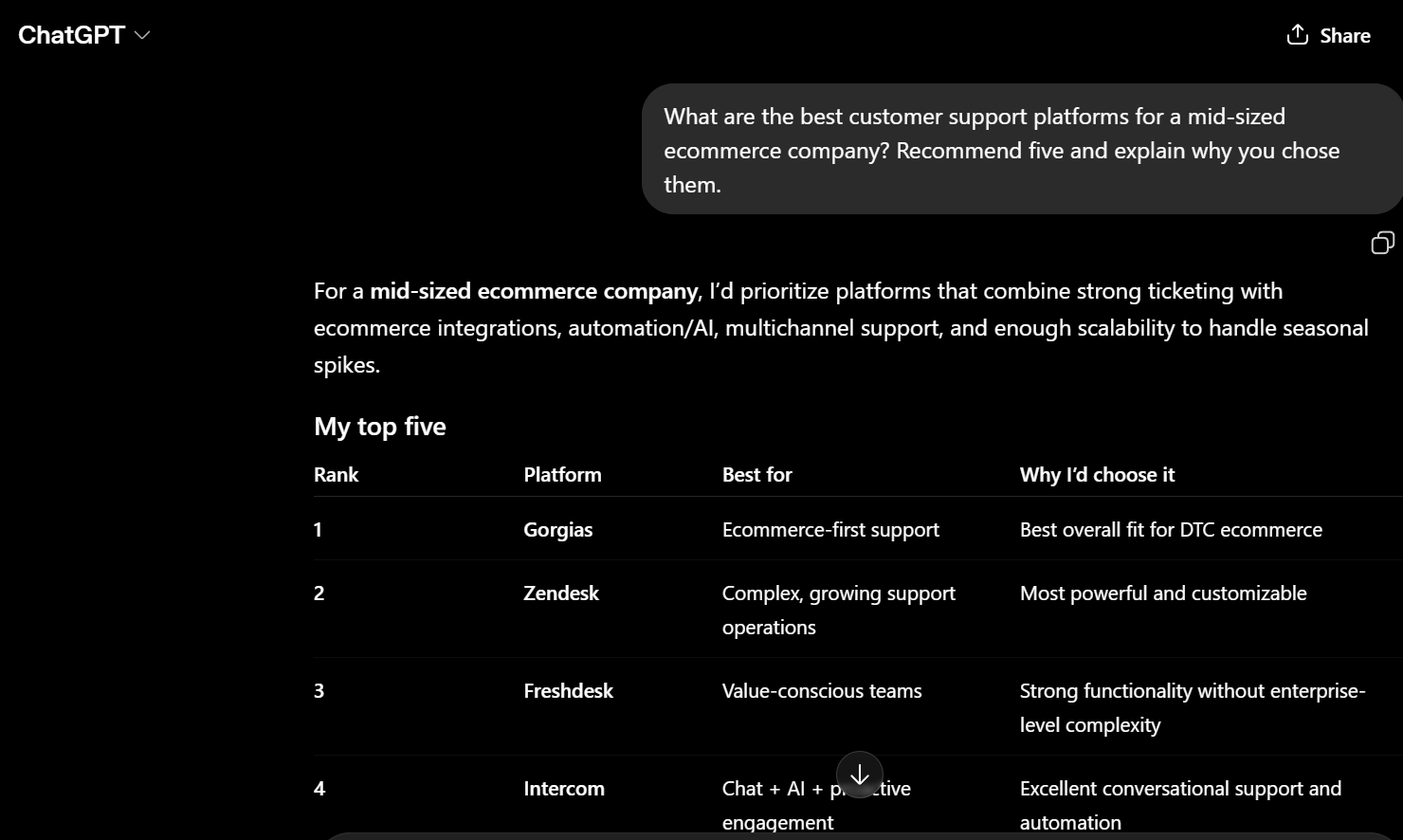
Then we changed one thing. The company was now a mid-sized ecommerce company.
Both models moved Gorgias to the number one position.
We made the buyer more specific again: a growing Shopify ecommerce brand with a 12-person support team that needed strong Shopify integration, automation for repetitive questions, and the ability to handle order issues without agents constantly switching tools.
Gorgias remained number one in both models.
Nothing about Gorgias had changed between those prompts. What changed was the buyer context.
For a generic customer support question, the broad category leader won. Once the question moved into ecommerce and Shopify support, the specialist became the preferred answer.
We Saw the Same Pattern in Project Management
To see whether this was specific to customer support software, we ran another test.
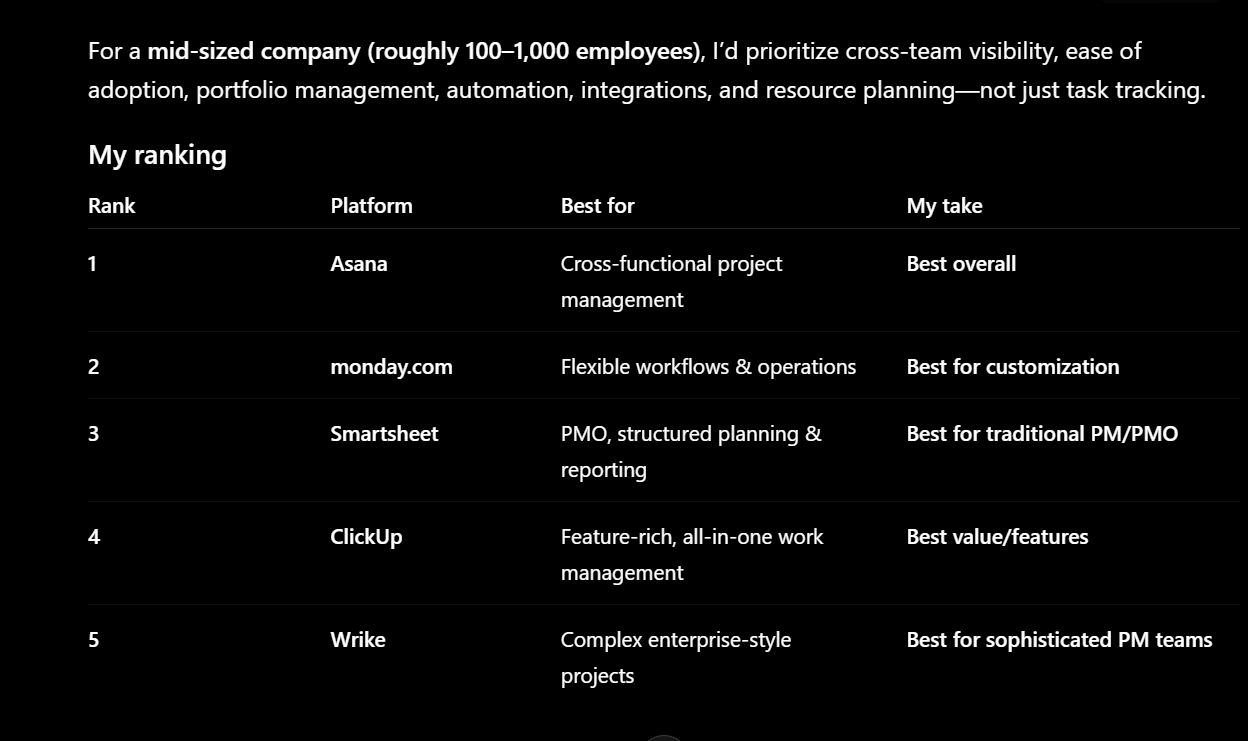
This time we asked for the best project management platforms for a mid-sized company.
Both ChatGPT and Claude ranked Asana first. Teamwork did not appear in either top five.
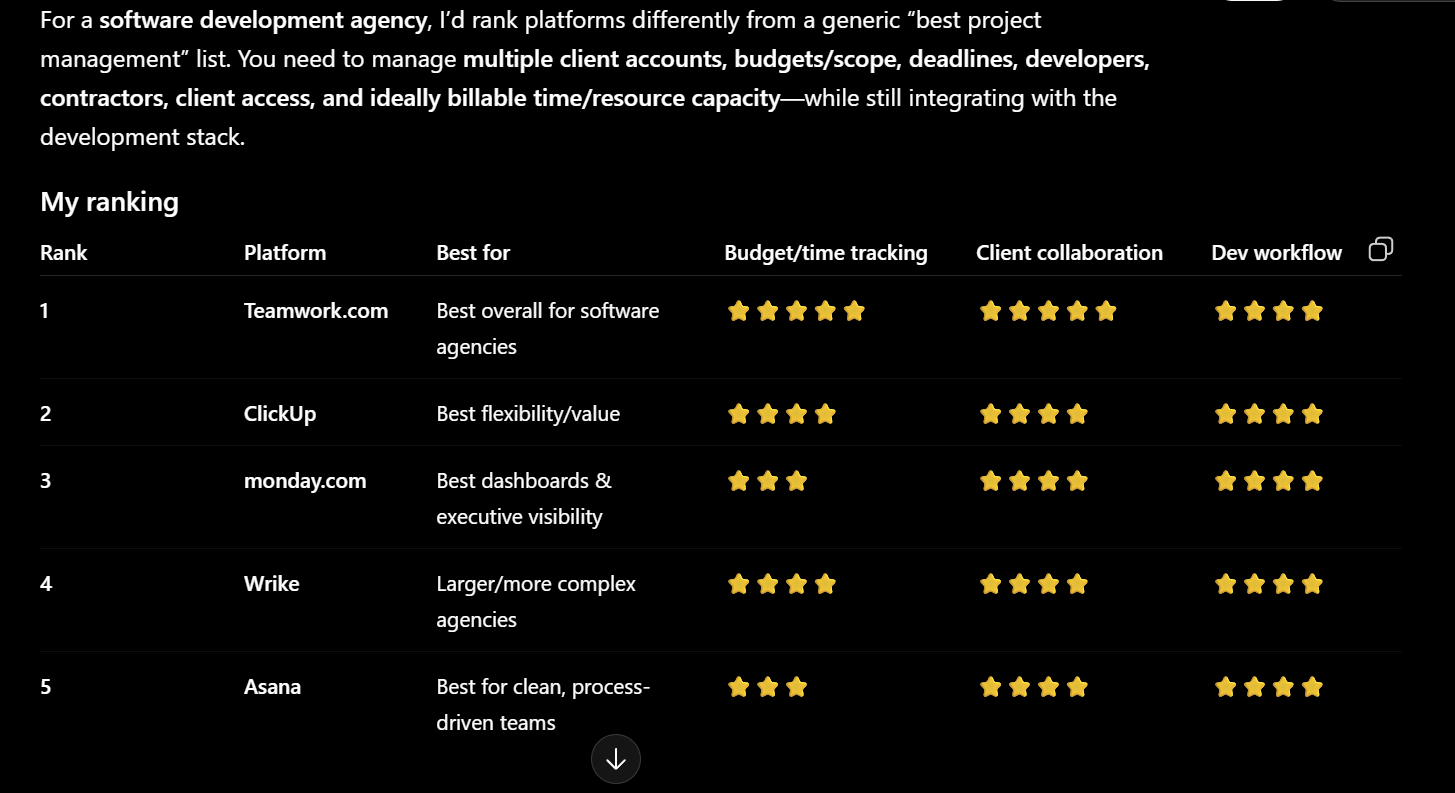
We then described the buyer as a software development agency managing multiple client projects, budgets, deadlines, and external collaborators.
The results became less predictable.
ChatGPT moved Teamwork to number one. Claude chose Linear instead, apparently giving more weight to the software-development part of the question. Teamwork did not make Claude's top five.
That difference was useful. Simply identifying the buyer as a software agency was not enough for both models to interpret what mattered to that buyer in the same way.
So we made the buying considerations explicit.
The agency now said that client collaboration, budget and time tracking, and resource planning were non-negotiable. Developer workflow mattered, but it was not looking for a pure engineering issue tracker.
Both ChatGPT and Claude ranked Teamwork first.
Again, the broad category leader had not become a worse product. The question had simply moved into a buying situation where another company was a clearer fit.
What Brand Positioning in AI Search Looked Like in Our Test
We then looked at how Gorgias and Teamwork position themselves.
The connection was hard to miss.
Gorgias describes itself as a customer support platform for ecommerce brands. Its Shopify integration puts order history, shipping information, customer data, refunds, and cancellations directly alongside support tickets so agents can work without moving constantly between Shopify and the helpdesk.
That is very close to the buying context that moved Gorgias to number one in our experiment.
And this association does not exist only on Gorgias's website. G2 describes the platform specifically around ecommerce, while current reviewers repeatedly mention Shopify integration and the ability to manage Shopify orders without switching between systems.
Teamwork shows a similar pattern.
Its main product positioning is “project management made for client work,” and its agency offering focuses on client collaboration, project budgets, profitability, resource management, and delivering work for multiple clients.
Third-party descriptions reinforce that association. G2 reviews from agency users emphasize billable client work, time tracking, budgets, workload planning, and profitability. Independent agency software comparisons also distinguish Teamwork from general-purpose project management tools based on client portals, time tracking, budgets, billing, and resource planning.
We cannot say that those specific pages caused ChatGPT or Claude to make the recommendations they did. AI systems can draw on many signals, and their exact weighting is not visible to us.
But there is a clear alignment:
What the company says it is good at → what the wider web associates it with → the buying situations where AI recommends it.
Smaller Companies May Not Need to Win the Category
This changes how a smaller company can think about AI visibility.
Trying to become the default answer to a broad question such as “What is the best project management software?” puts a smaller company directly against brands that have years of recognition and a much larger information footprint.
But buyers do not always ask questions that broadly.
They add context.
They say what kind of company they run. They describe the problem. They mention the capabilities they need. They explain what matters more and what matters less.
Our tests suggest that this additional context can materially change which companies AI recommends.
For a smaller company, that makes brand positioning in AI search especially important.
It needs to be clear about more than the category it competes in. AI needs enough evidence to associate the company with questions such as:
- Who is this product especially well suited for?
- What problem does it solve particularly well?
- Which requirements make it a stronger choice than a broader competitor?
- What should make a buyer choose it instead of the category leader?
The narrower company can then have an advantage the broader company does not: a clearer answer to a particular buying situation.
Positioning Cannot Stop at Your Homepage
There is another important lesson in the Gorgias and Teamwork examples.
Both companies make their positioning clear on their own sites, but that positioning also shows up elsewhere.
That matters because a company saying it is “the best platform for agencies” is only one claim. Reviews, comparisons, customer experiences, documentation, partner content, and other independent sources can reinforce or weaken the association.
A smaller company therefore has two jobs.
First, decide which buyers and buying considerations it wants to be strongly associated with.
Then look at whether the public evidence around the company supports that positioning. That is also something companies can audit directly. Our guide to brand positioning in AI search looks at whether AI associates a company with the right buyers, business drivers, and perceptions.
If your site says you are built for enterprise security teams, but reviews, comparisons, customer stories, and product documentation give AI little evidence of enterprise use, the positioning may be difficult to carry into a recommendation.
The goal is not to make every source repeat the same marketing line. It is to make sure the association you want AI to understand has enough real evidence behind it.
The Opportunity Is Not to Be Recommended for Everything
This was a small experiment. It covered two categories, a limited set of prompts, and two AI systems. It does not prove that positioning alone determines AI recommendations. Brand familiarity, retrieval, reviews, source coverage, model behavior, and many other factors can affect an answer.
But the pattern was consistent enough to matter.
Gorgias disappeared from the generic customer support recommendation and became number one when the buyer became an ecommerce company.
Teamwork disappeared from the generic project management recommendation and became number one on both models when the buyer described the agency-specific requirements Teamwork is strongly associated with.
For a smaller company, that suggests a different goal from simply trying to match the AI visibility of the largest company in its category. Strong brand positioning in AI search is about making the situations where you are the better fit clear enough for AI to recognize.
You may not need AI to think you are the best company for everyone. You need it to understand exactly when you are the better choice.