When an AI assistant recommends a GPU cloud or an inference platform, where does it get its evidence?
The obvious, but incomplete, answer is the vendor’s website.
We ran 141 prompts across the managed AI infrastructure, GPU rental, and inference-as-a-service market. The prompts covered several stages of the buying journey, from early research to vendor comparison. They explored various considerations a buyer might have: predictable cost, production readiness, performance, elastic capacity, hardware support, model support, setup time, competitor research, and vendor shortlisting.
We then studied the sources that contributed to answers in which brands were mentioned. The audit surfaced 165 source domains and 628 contributions to brand-related answers.
The source mix threw up a few surprises.
| Category of Sources | Source Domains | Total Contributions of Brands Mentioned in AI Audit |
|---|---|---|
| AI Infrastructure Provider sites | 38 | 304 |
| AI Applications and Vertical Software | 26 | 80 |
| UGC & Knowledge Communities | 16 | 63 |
| Directories & Reviews | 20 | 60 |
| Agency & 3rd-Party Blog | 13 | 54 |
| Analyst, Media & Research | 9 | 21 |
More than half of all contributions came from websites of AI infrastructure vendors. That part made sense. But the second-largest group was not analysts, technology publications, or software review platforms.
It was made up of AI tooling companies that use these infrastructure platforms.
We also discovered a new set of Pricing / Comparison Directories spawned by the main category!
What We Did
We wanted to understand the source environment behind AI’s query responses.
We simulated the persona of a Co-founder at a startup seeking managed AI infrastructure. They might have different considerations based on their stage in the Purchase Journey. These considerations were translated to AI Queries that were executed using Gemini.
The 141 prompts were distributed across the following considerations:
| Co-founder’s Consideration |
| General: These are awareness queries about renting GPUs or MaaS or inference. |
| Predictable cost: Queries that focus on predictability of cost - as the workload matures. |
| Production ready: The buyer is looking for a platform that is stable in production with predictable throughput. |
| Performance - Latency and throughput: Inference latency, number of parallel inferences, training time. |
| Elastic capacity and availability: How easy it is to scale? How quickly does it scale up and down? |
| Hardware ecosystem breadth: Which all hardware are supported? |
| Model ecosystem breadth: Support for latest and popular modules |
| Time to value: How quickly can I set up training/inference? |
| Competition research: The buyer is considering a competitor and is researching about them. |
| Competition compare: The buyer is explicitly searching for alternatives for a competitor. |
| Brand Validation: The user is aware of the brand and is fact-checking. |
An AI assistant will not answer a complex prompt from one source. It may break the request into smaller searches, retrieve evidence from several sources, and combine the findings into one response.
Our proprietary tooling allows us to execute these prompts across multiple models and analyse the results across different dimensions. In this particular case, we executed the prompts using Gemini and analysed the sources that were cited.
AI Search Synthesises Responses from the Whole Ecosystem
Traditional SEO often divides the web into two parts: Your website and everyone else’s website. An AI system, on the other hand, breaks this down into several layers.
- Your website explains what the product does.
- A customer explains how it works in practice.
- A partner explains how it fits into a wider workflow.
- A comparison site organizes pricing or product differences.
- A community discusses limitations, implementation problems, and real-world experience.
The final answer may draw from all of them.
Your website remains important as it is the primary source for product facts, documentation, pricing, benchmarks, supported hardware, and technical capabilities. But your brand is also being explained by other companies in the ecosystem. Sometimes, those companies may drive your narrative for you.
Your Users Might Be Driving The Narrative
One of the most interesting source categories in the audit was AI tooling vendors.
These were the users of the managed infrastructure providers. These users are building AI products, agents, developer tools, and applications. Yet their websites discussed infrastructure platforms such as Replicate, Modal, and others.
The content included pages such as:
- Best Replicate alternatives for AI inference
- Best Replicate pricing tools
- Replicate MCP integrations
- What is Replicate?
- Best Modal alternatives for developers
Given below are two samples:
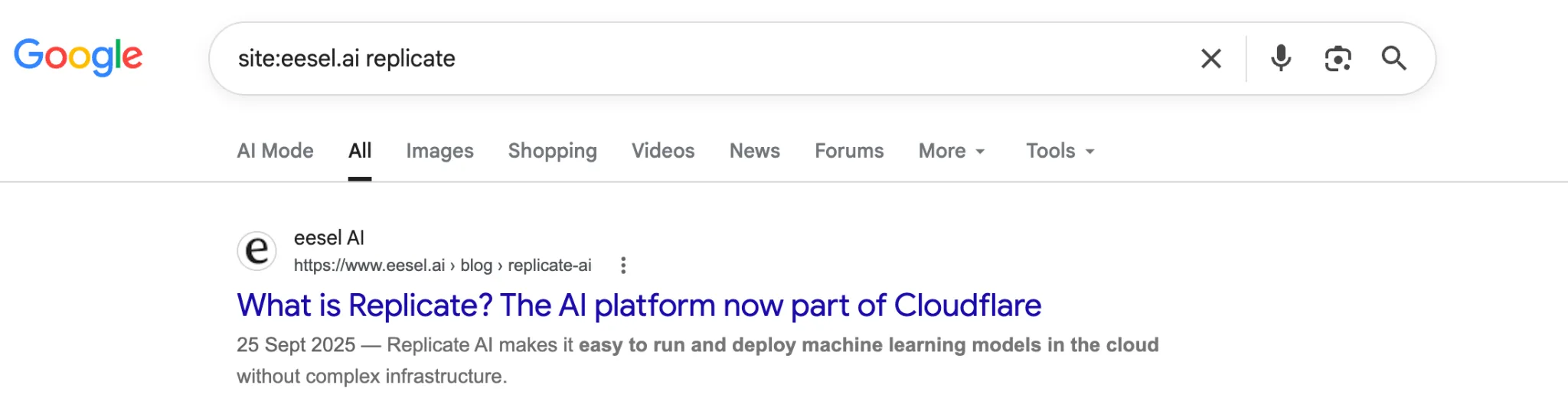
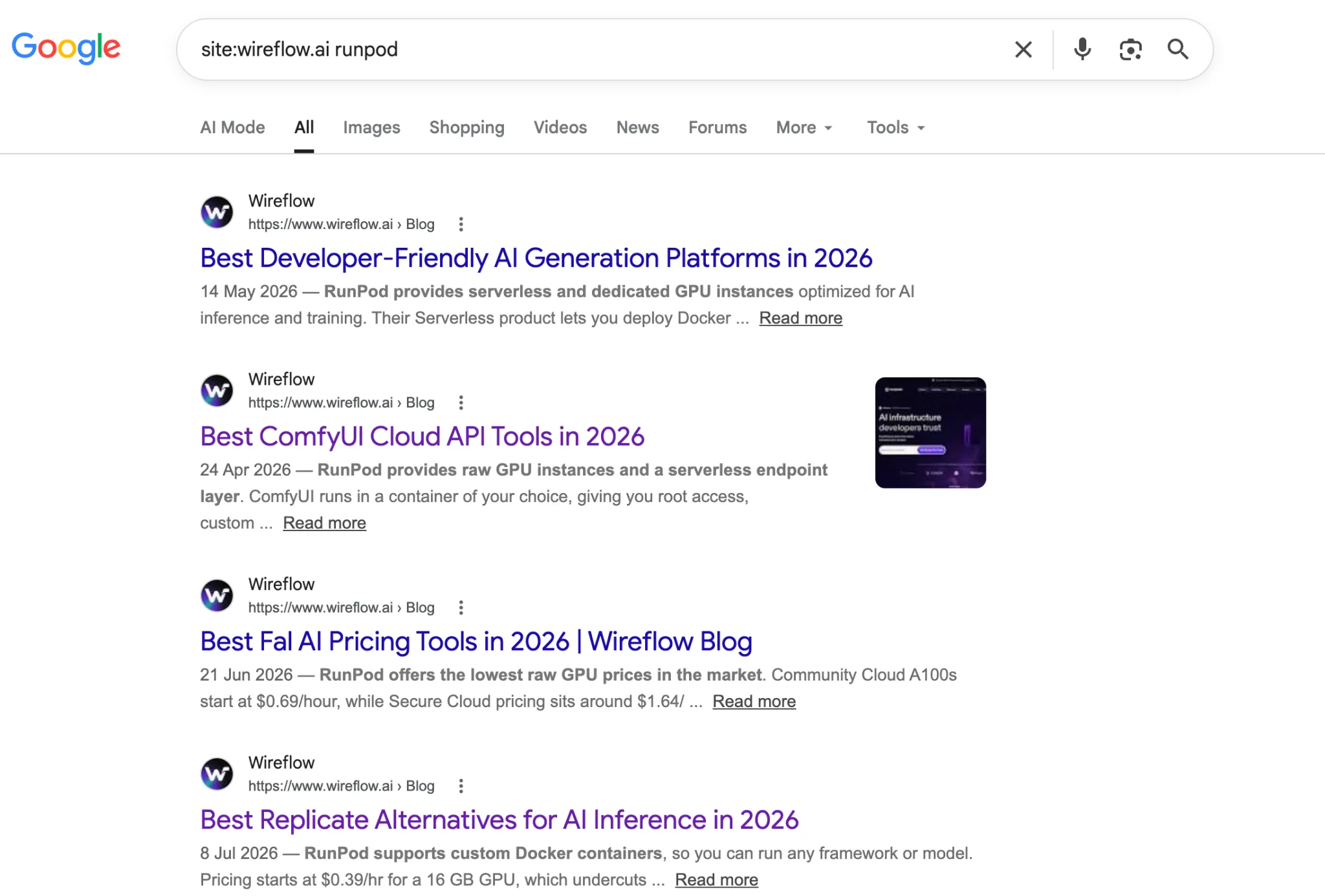
The lesson is simple: In AI search, downstream users can become upstream sources of brand perception. Specifically, many AI Applications provide value-add over the AI infrastructure they use and are, in a way, a competitive alternative for a specific subset of use cases addressed by AI infrastructure vendors.
Hence, the AI application vendors also write about AI Infrastructure as part of their content strategy.
Is your competition featuring in their customer and partner content? Is it becoming part of the evidence used to understand the brand?
There is a major difference between the following mechanisms:
- A case study on your website that shows how your product is trusted by Company X
- A blog on Company X’s website that describes how it uses the platform to deploy image-generation models across four regions, with automatic scaling and usage-based billing.
The first might be construed as self-promotion, while the second definitely carries a lot more weight.
We Also Found a New Class of Website
Another category stood out during the source classification: pricing and comparison directories. We identified 16 domains in this group. Together, they contributed 37 times to answers mentioning brands.
These were not conventional software review sites, but a completely new category that has evolved.
They focus on questions such as:
- Which GPU is available from which provider?
- What is the hourly price?
- How do cloud GPU prices compare?
- Which providers support a particular instance?
- What is the likely cost of running a workload?
- Which service offers the best price-performance trade-off?
These sites often organize complex markets into structured fields and provide API access to the data. This structure makes them useful for both the Humans and the Machines.
While the traditional directories helped buyers discover vendors, these newer sites help AI agents compare them.
Think of these newer sites as decision-data websites. A few examples include:
| gpuperhour.com | cloudgpuprices.com | gpufinder.dev |
| aipricing.guru | cloudgputracker.com | gpus.io |
| getdeploying.com | computestacker.com | gpusmith.com |
| computeprices.com | whatllm.org | neuralcatalog.com |
The AI Source Stack
The findings can be organized into four layers.
Layer 1: First-Party Truth: Product pages, documentation, pricing pages, benchmarks, FAQs, and case studies.
Layer 2: Ecosystem Evidence: Customers, integration partners, AI tooling vendors, and implementation guides. These show where the product fits and how it is used.
Layer 3: Decision Infrastructure: Pricing databases, comparison directories, software listings, and analyst research. These help compare vendors through structured criteria.
Layer 4: Market Experience: Communities, forums, tutorials, independent blogs, and user-generated content. These add practical experience and criticism.
An AI answer may use evidence from every layer. A brand that is strong in only one may still struggle to shape the final synthesis.
What This Changes About AI Visibility Strategy
Brands have to approach AI visibility as not only a content-volume problem.
- Publish more pages.
- Add more FAQs.
- Target more questions.
That definitely helps, but it does not address the full source environment. The better question is:
Who is currently informing AI about this category, and what are they telling it about us?
This “source audit” leads to a different set of actions. You end up discovering all the layers!
A brand may have strong evidence for hardware breadth but weak evidence for production readiness. It may be visible in general prompts but absent from cost comparisons.
A source audit should show which domains support the brand on cost, performance, scale, model availability, and setup time.
Let us consider another example.
Imagine that a company wants to be known for predictable inference costs. Its website uses the phrase “cost-efficient.” But specialist pricing sites do not include it. Customers do not discuss cost predictability. Tooling vendors describe it mainly as easy to use. Communities focus on performance.
The company may believe it owns the cost narrative. A source audit helps it understand the blind spots.
The Website Is Not the Full Unit of AI Visibility
The unit of visibility is no longer only the webpage, keywords, and backlinks. It is the source stack around the brand. That ecosystem includes the company’s own content. But it also includes customers, partners, tooling vendors, pricing databases, comparison sites, communities, and independent publishers.
AI does not synthesise your position from your positioning statement alone. It learns from the trail of evidence your company, customers, partners, users, and market leave across the web.