Most law firms are beginning to notice something unusual.
They appear in AI-generated answers. They are mentioned alongside credible peers. And yet, they are not consistently recommended by the AI.
The instinctive response is to push for more visibility. More content. More presence.
But that is not the problem. What has changed is not how often you appear. It is how you are understood.
AI search does not operate like traditional discovery. The AI sorts and judges firms before the user ever sees a name. To understand why firms are being selected, or ignored, you need to look beyond visibility. You need to examine how your firm is being interpreted across a set of underlying signals.
Here are the six lenses, and the seventh that ties them together.
AI Search for Law Firms: Why Visibility Alone Doesn’t Work
Most firms begin here: they track how often they appear and take comfort in high visibility. On the surface, this looks like progress.
But AI does not reward presence alone. It constructs shortlists. And within those shortlists, being one of many is not enough. A firm can show up everywhere and still look like everyone else.
That is the gap. Visibility means being mentioned in the AI’s answer. It does not mean the AI recommends you.
Most firms try to improve visibility by expanding coverage: adding more pages, more topics, and more keywords. But AI does not reward breadth. It rewards clarity.
The shift is towards owning a context.
Instead of trying to appear across every possible query, firms need to define the specific contexts they want to dominate. These contexts are precise: a type of transaction, a level of complexity, a client profile.
When a firm becomes consistently associated with a specific context, it stops being one option among many. It becomes the expected answer.
Why Law Firms Fail to Reach Decision-Makers in AI Search
Not all visibility carries the same weight. Visibility to the wrong persona is worthless.
A firm may appear frequently in general queries and still be absent where it matters most, in decision-stage queries from senior stakeholders.
In legal services, this distinction is critical. The way a general counsel evaluates a firm is very different from how others search. Their queries are more specific, more risk-aware, and more closely tied to outcomes.
AI reflects this difference. It adapts responses based on inferred intent and persona. This creates a subtle gap. A firm may be visible to many personas, but not to the decision-maker.
What needs to change is alignment.
Most firms communicate broadly. They describe services, capabilities, and sectors. But decision-makers do not think in those terms.
Consider general counsels. They think in terms of risk, precedent, and defensibility.
Content and signals need to reflect how your client makes decisions.. That means explaining not just what the firm does, but how it approaches complex situations, what kind of work it is trusted with, and why it is chosen in high-stakes scenarios.
When a firm starts appearing inside the logic of decision-making, not just the surface of discovery, its visibility becomes meaningful.
How AI Selects Law Firms: Drivers Matter More Than Presence
AI systems do not randomly recommend firms. They map them to decision drivers of the client: such as track record, fit for the client’s specific use case, reputation, and the ability to handle complexity.
A firm may appear when AI explains how to choose a legal advisor. It may be part of the broader discussion. But it may not be strongly associated with the factors that matter most for the client’s context. AI will ignore the firm or mention it in passing.
Look at the image below. It shows how different Law Firms appear in prompts tagged to various decision drivers.
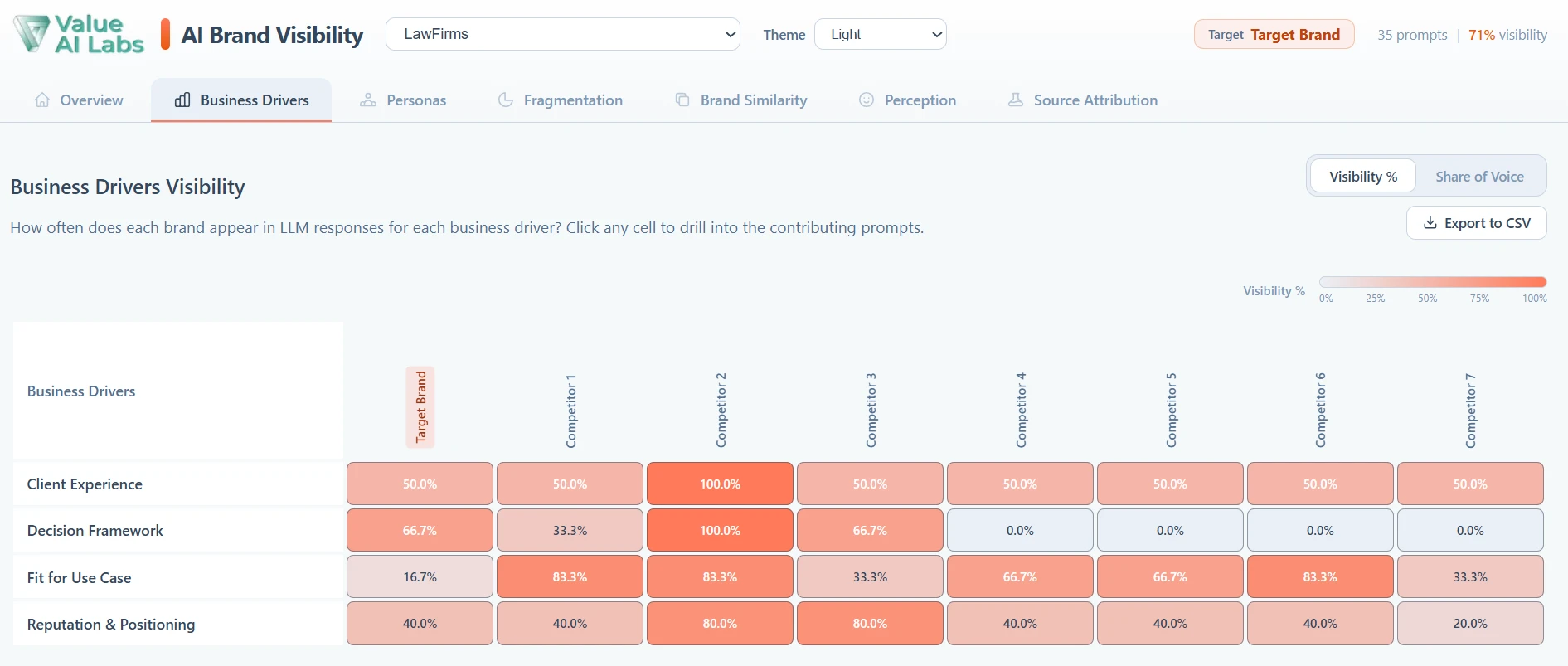
This is where many firms fall short. They are present in the conversation. But they are not selected for the mandate.
The difference lies in how clearly the firm is linked to specific decision drivers. Weak or inconsistent association means the system ignores you. Tight mapping means you get selected.
What needs to change is not volume, but structure.
Most firms respond by producing more content. AI doesn't care how much you write. It cares how often you say the same thing.
The real shift is towards content re-engineering.
Existing materials, practice pages, deal descriptions, directory submissions, and partner bios need to be rewritten to consistently reinforce:
- What type of mandates is the firm best suited for
- What level of complexity does it handle
- and in what situations it should be chosen
When these signals are aligned across sources, AI begins to associate the firm with the right decision drivers. That is when visibility starts converting into selection.
AI Search Is Fragmented: Why Law Firms Compete Beyond Traditional Peers
We used to think we knew exactly who we were up against. A handful of known firms, a familiar hierarchy, and predictable comparisons. AI does not operate that way.
For every query, it reconstructs the market. It pulls from a wide pool, large firms, regional players, niche specialists, and builds a context-specific shortlist.
The result is fragmentation.
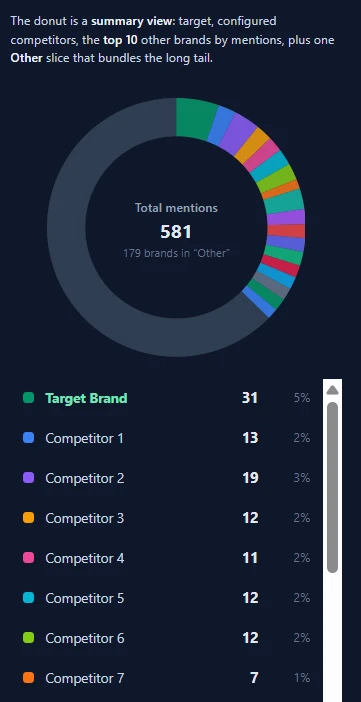
Even strong firms can disappear in certain contexts, not because they lack capability, but because others are more tightly aligned with the query.
This changes the nature of competition.
Firms are no longer competing for overall visibility. They are competing for relevance within specific situations.
What needs to change is not only positioning, but prioritization.
Most firms try to maintain a broad, all-encompassing positioning. In a fragmented system, that leads to dilution.
The shift is towards niche dominance.
Instead of trying to win across the entire market, firms need to identify a number of high-value contexts and build a deep, consistent association with them. Over time, this creates default recognition within those contexts.
AI does not reward general strength. It rewards contextual authority.
How AI Groups Law Firms: Understanding Brand Positioning and Similarity
Every time AI generates a response, it groups firms. They determine who you are compared with, and by extension, how you are perceived.
A firm that consistently appears alongside top-tier peers is assumed to belong in that tier. A firm that appears in broader or mixed clusters is interpreted differently.
This happens silently, but it dictates who gets the call. Positioning is no longer defined only by what you say. It is defined by who you appear with.
What needs to change is not your message, but your associations.
Most firms focus inward, on their own website, their own materials. But AI learns positioning through patterns of co-occurrence.
The shift is towards signal engineering.
This involves ensuring that the firm is consistently mentioned in the right contexts, alongside the right peers, and within the right narratives. External placements, deal visibility, and third-party references all contribute to this.
Over time, these patterns redefine how the firm is grouped, and therefore how it is perceived.
From Mention to Recommendation: How AI Frames Law Firms
AI answers do not just include firms. They frame them.
Some firms are described with strong, positive language. Others are listed neutrally. In some cases, firms are implicitly positioned below others.
These differences are subtle, but they are decisive. In high-stakes decisions, where only a few firms are seriously considered, even slight variations in framing can determine outcomes.
A firm that is consistently described as “leading” or “specialized in complex transactions” is treated differently from one that is simply listed without distinction.
What needs to change is not presence, but perception.
This requires consistency in how the firm is described across all sources. The same positioning, the same descriptors, the same narrative needs to appear repeatedly.
Over time, this consistency translates into stronger, more favorable framing in AI-generated answers.
Why External Sources Influence AI Visibility for Law Firms
AI does not rely on a single source. It assembles a narrative from multiple inputs, firm websites, directories, rankings, publications, and other third-party references.
When a law firm’s positioning exists primarily within its own content, it remains a claim. When that positioning is repeated across independent sources, it becomes an accepted reality.
This is where many firms are constrained. They underinvest in external validation.
What needs to change is not messaging, but distribution.
Specially in case of Law Firms, our audit has shown the significance of external directories. Refer to the results here.
AI does not decide what is true. It identifies what is consistently said across sources.
From SEO to AI Search Optimization: The Shift Law Firms Must Make
Taken together, these lenses point to a deeper shift. Most firms try to fix AI visibility by creating more content. The firms that succeed take a different approach. They focus on re-engineering how they are understood.
They align their signals across contexts, personas, sources, and narratives. They ensure that the same positioning is reinforced consistently until it becomes the default interpretation.
That is what turns presence into selection.
Do you know where AI is misreading your firm’s positioning?
If you want to understand how your firm is being interpreted across these dimensions, and where the gaps lie, an AI Visibility Audit for Law Firms provides a structured way to diagnose and improve your positioning.
Request an AI Visibility Audit for Law Firms